
"René Bégué started as a delivery boy for a lace house in Paris in 1903. He died in 1987 at 100 years old. In between, he dressed Balenciaga, Dior, and Givenchy — and almost nobody remembers his name."
At Temperley London, Alice kept the French lace in climate-controlled storage. Not hanging. Not folded carelessly into a bin. Stored in lengths — full, uncut, pristine — because that was the only way to treat it. When a bride came in and fell in love with a particular lace, we would dispatch it with the kind of care you reserve for something irreplaceable. Which it was.

Detail: French floral lace. Rendered via Midjourney — because the original deserves a climate-controlled room.
I was the Chief Merchandising Officer — the bridge between design to commercial - and the loop. By then I had managed made-to-order at Ralph Lauren's Purple Label, handled millions of dollars worth of the finest outerwear fabrics at Burberry, worked with the military uniform makers & embroiderers who dress the Queen's Bodyguard at Gieves & Hawkes. Bridal was new territory. Alice's embroideries were her signature, and working with her was a dream come true. The lace was stored with the respect of a museum collection — dispatched to be embroidered, returned, and made into something one of a kind. Not a supply chain. A work of art. Alice made dreams come true.
"Alice Temperley created a world — not just a collection. Walking into her atelier was like stepping through a looking glass: everything was more considered, more beautiful, more intentional than the world outside."
Some things deserve to be handled that way.
René Bégué started as a delivery boy for a lace manufacturer in Paris in 1903.
He died in 1987, at one hundred years old.
In between, he dressed Balenciaga, Dior, Givenchy, Lanvin, Yves Saint Laurent, and nearly every other name we consider the canon of 20th-century haute couture. The petaled skirt of Dior's celebrated Junon gown — individually shaped, dyed, and beaded — came from his atelier. The extraordinary tridimensional surface of Balenciaga's Spring/Summer 1947 collection — soutache, sequins, cabochons — came from his workshop.
Almost nobody knows his name.
His house was called Rébé — the first two letters of René, the first two of Bégué. Founded in Paris in 1911 with his wife Andrée, it operated for 56 years and closed in 1967. In that time, Rébé became the invisible infrastructure of the most iconic garments in fashion history.
Balenciaga got the credit. Dior got the credit. René Bégué stitched the surfaces that made the credit possible.
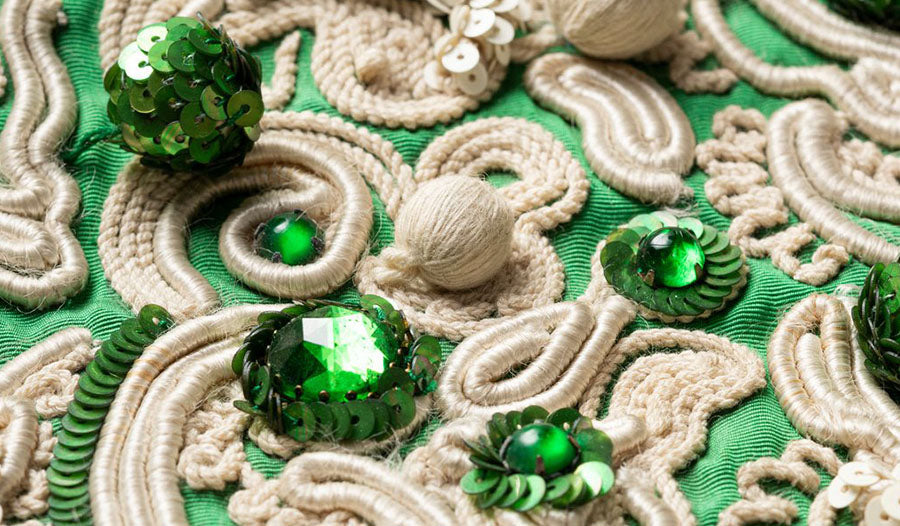
Rébé had a signature technique called nuanced paillettes — sequins hidden partly beneath threads and other materials, so the shimmer was controlled, restrained, present but never obvious. The light was there if you knew to look for it. That is the philosophy of a craftsman who understood that the best work serves the work, not itself.
Many couture designers of the era didn't start with a silhouette. They started with a Rébé embroidery sample — a large, dress-front-sized composition of pearls and sequins and beads — and built the gown around what the surface demanded. The embroidery came first. The dress followed.
Think about that. The name on the label built around the work of a name nobody knew.
In 2016, a fashion historian named Nadia Albertini discovered Rébé's archives. She spent three years retracing the story — Paris to London, interviewing surviving embroiderers and designers — because the quality of what she found was, in her words, completely unknown by the public. She published a monograph. There is now a podcast episode. A small community of people who care about this deeply.
For most of fashion history, Rébé stayed in the room with the lace. Climate-controlled. Preserved. Known only to the people who actually had to work with what they made.
I think about Alice when I think about Rébé. Not because the stories are the same — they aren't. But because both of them understood something that fast fashion never will:
The material is not the raw ingredient. The material is already a decision. Every length of French lace in that storage room was a future gown that hadn't been made yet — but it already had integrity. Already had a point of view. Already deserved to be handled as if it mattered, because it did.
René Bégué understood this at the level of individual stitches. He hid the sequins so the light came through softly. He built surfaces that made other people's vision possible and didn't ask for the credit.
Every stitch has an author. Most of them, we never learn.
Rébé operated 1911–1967. Their work is archived at the Musée des Arts Décoratifs in Paris and the National Gallery of Victoria. Nadia Albertini's monograph Rébé Broderies Haute Couture is the definitive resource if you want to go deeper.


Rébé's Role in Balenciaga SS1947
Balenciaga’s SS1947 show included evening gowns with lavish beaded and sequinned surfaces on tulle, where Rébé’s atelier excelled. They created dense, floral and abstract motifs using their signature technique of partially concealed paillettes under layered threads and beads, giving a refined shimmer rather than overt sparkle. These embroideries adorned key pieces like multi-tiered ballgowns and cocktail dresses, enhancing Balenciaga’s architectural silhouettes with organic, sculpted detail.
This collaboration reflects Rébé’s rising status in the late 1940s, as Cristóbal Balenciaga sought out specialist ateliers to elevate his vision. Their Paris workshop delivered large-scale samples that often dictated the final garment shape, a practice Rébé honed since the 1910s. While specific gown documentation is scattered (many archives were lost or dispersed), surviving references and museum pieces confirm Rébé’s embroidery appeared on Balenciaga’s most collectible post-war designs.[2][3]
Sources [1] Screenshot-2026-03-20-at-8.58.49-PM.jpeg https://ppl-ai-file-upload.s3.amazonaws.com/web/direct-files/attachments/images/21437019/0c1a4c0a-e5ac-4339-8ef5-d82d3e66c427/Screenshot-2026-03-20-at-8.58.49-PM.jpeg [2] Christian Dior's Junon dress (Fall/ Winter 1949) is one of ... - Instagram https://www.instagram.com/reel/DTk_JQWDPQC/ [3] rebe - Gourcuff Gradenigo http://www.gourcuff-gradenigo.com/rebe.html