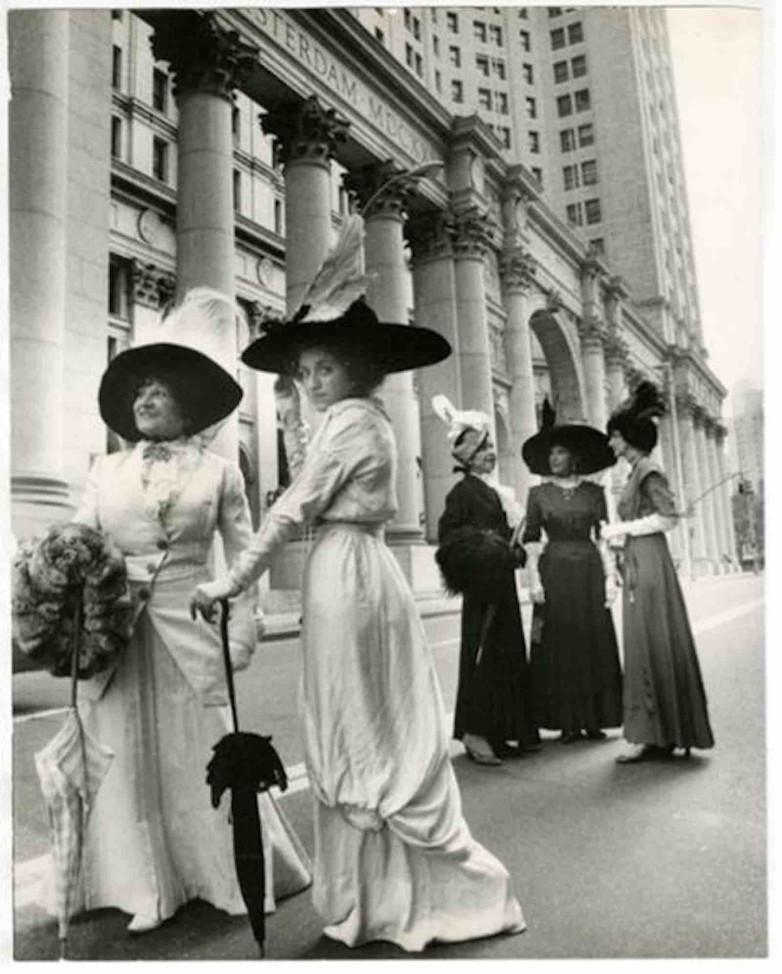
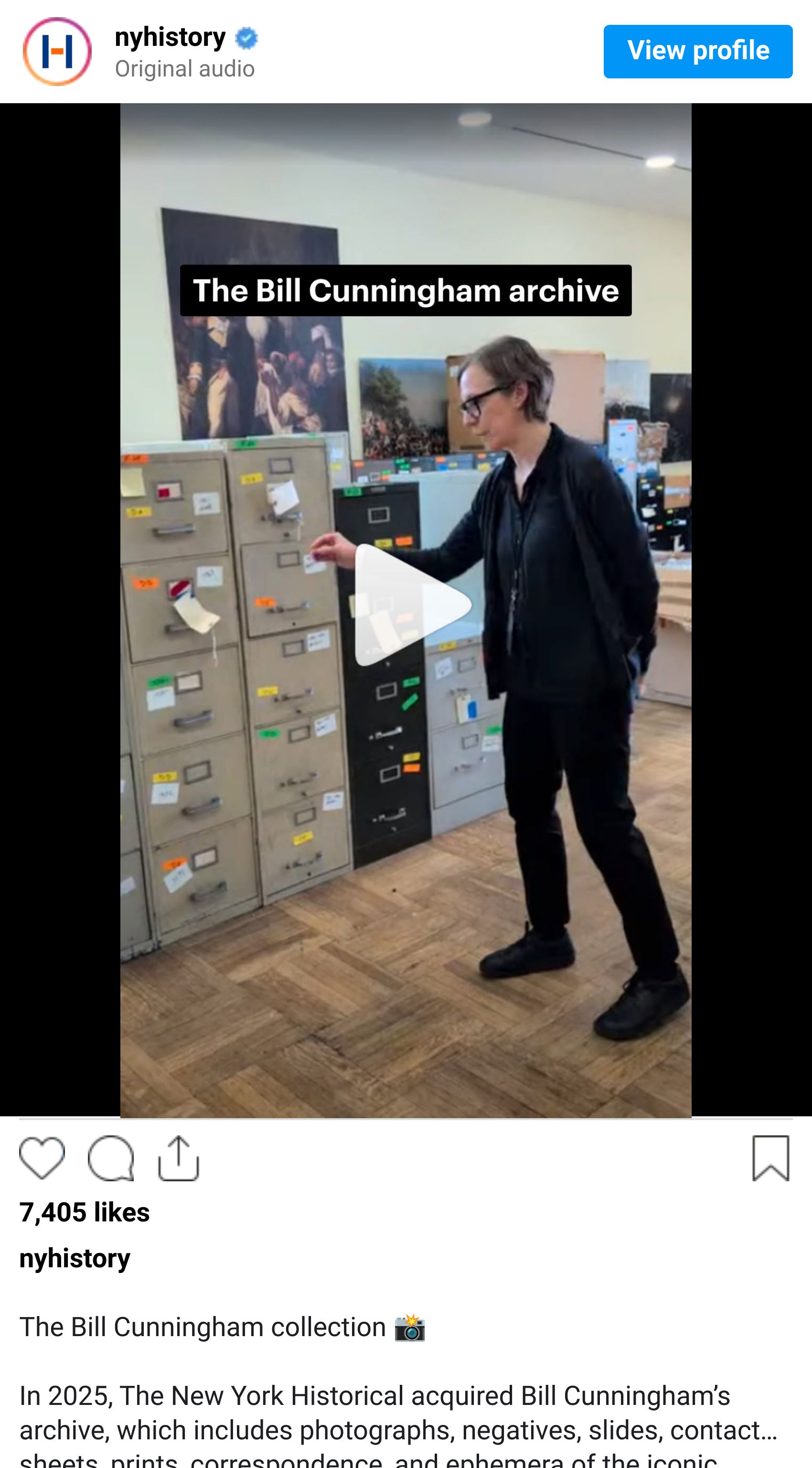
The New-York Historical Society just acquired Bill Cunningham's archive.
Tens of thousands of images. A lifetime of street fashion, shows, and rooms that mattered.
Most people look at that story and think: fashion history.
I read it and think: leverage.
Because an archive isn't just storage. It's a weapon against forgetting. It's a way of saying: this happened, I was there, and I can prove it.
Archives are not nostalgia. They're infrastructure.
I've spent years digitizing my grandmother's genealogical work—not out of sentiment, but out of refusal to let generations of family history disappear into fragile paper and fading memory.
I do the same with my own work. Those DOS-based CAD sweater graphs from 1992? The hand-drawn woven patterns on graph paper? The press clippings from building Burberry's first global womenswear team?
They're not nostalgia. They're proof.
And in a world where everything disappears—platforms change, accounts get locked, links rot, files scatter—the people who win long-term aren't only the ones who create.
They're the ones who keep a record.
Why Bill Cunningham matters (even if you don't care about fashion)
Cunningham wasn't just documenting outfits. He was documenting change.
Street fashion is culture moving in real time. And his superpower was simple: he showed up. Again and again. He captured what other people dismissed as noise.
That's what an archive does. It turns the "noise" into a pattern.
As a fifth-generation merchant, I understand this instinctively. My family didn't build businesses by chasing trends—they built them by understanding what endures. By keeping records. By knowing what worked before so they could build better next time.

🙂
The archive is your second engine
An archive turns your work into leverage you can compound.
You stop starting from zero. You start from proof.
When I'm consulting with heritage brands now, I don't just tell them to preserve their archives—I show them mine. The evolution from DOS CAD systems to modern PLM to today's AI-integrated ecosystems isn't just my career story. It's documented proof that I've been ahead of the curve for 30 years.
That documentation creates credibility that no résumé can match.
The simplest archive you can build (starting today)
You don't need a perfect system. You need a consistent one.
Here's the basic framework:
Capture the artifact (screenshot, doc, photo, voice note, draft)
Describe it (one sentence + date + who/what/where)
Store it in one primary home (Notion, Drive, Dropbox—pick one)
Index it (tags that match how you search: person, project, place, theme)
Retrieve it regularly (make "search your own archive" a habit)
That's it. The rest is polish.
Why this matters for your work (not just your legacy)
Bill Cunningham didn't just leave images. He left a map.
And that's why institutions acquire archives—because a good archive doesn't just preserve the past. It makes the future easier to build.
In my work with luxury brands, the ones that understand their archives are the ones that innovate confidently. They know what made them special. They can trace their DNA. They can point to proof.
Burberry's heritage archive informed every collection decision I made there. Gieves & Hawkes' 250+ years of Savile Row history wasn't a museum piece—it was our competitive advantage.
Your archive is your superpower—if you build it intentionally.
The real point
An archive is a bet on your future self.
It's saying: I trust that this work matters. That these moments compound. That showing up consistently creates something larger than any single day's output.
My grandmother understood this when she traced our family back fifteen generations.
Bill Cunningham understood it when he shot the same street corners for decades.
I understand it every time I digitize another box of press clippings or scan another hand-drawn pattern from my FIT days.
Because the people who win aren't always the ones who create the most.
They're the ones who remember—and can prove—what they built.
Connect with me: If this resonates, I share more about building systems for creative and professional work on LinkedIn and through this newsletter.